

As always in dementia care, any behavioural change should first be evaluated for possible medical causes. Consulting the GP helps rule out issues such as pain, infection, or medication side effects before focusing on emotional or environmental factors.
If you’ve read some of my blog posts, you may have noticed how often I refer to Sonia Lupien's N.U.T.S. model to make sense of a person’s stress response. According to this model, stress occurs when one or more of the following four ingredients are present: Novelty, Unpredictability, Threat to the ego, and a low Sense of control.
In dementia care, what we often call “negative” or “challenging” behaviours are rarely random. They can be expressions of distress and signals of unmet needs. The N.U.T.S. model not only offers a simple, compassionate lens for understanding where this distress might come from. It also helps us anticipate stress before it arises.
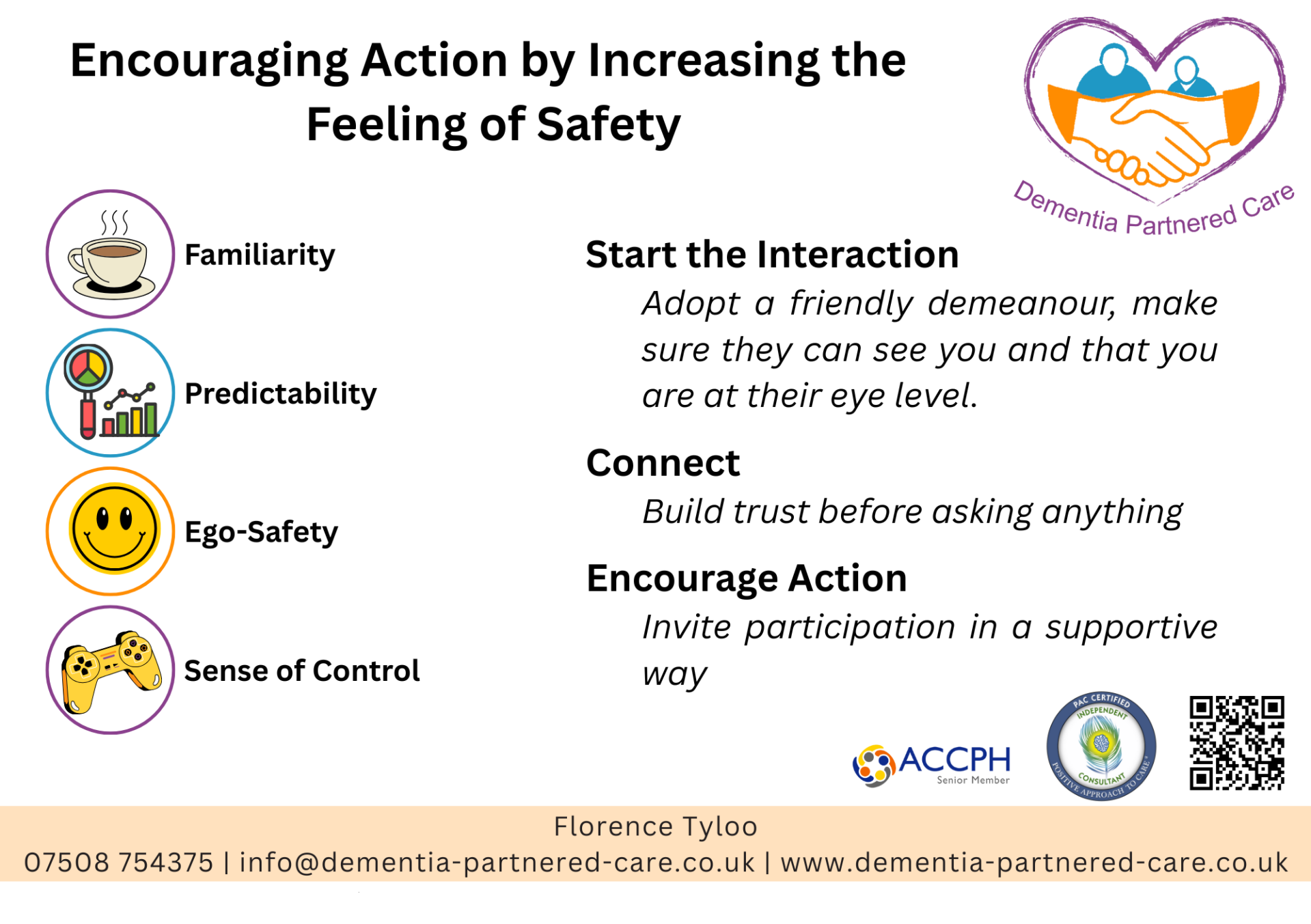
By adjusting the environment and our approach to maximise familiarity, predictability, ego-safety, and a sense of control, we reduce the person’s instinctive survival responses—fight or flight. In doing so, we give them the sense of safety they need to feel grounded and to thrive.
And let’s be honest: when they’re thriving, we are too.
So how do we actually do this in everyday care? Let’s break it down into three simple steps that you can then personalise and adapt to almost any situation:
- How you approach the person
- How you connect with them
- How you guide the action
These steps can help create the safety and trust your loved one needs to participate more willingly.
1. Starting the Interaction
The beginning of an interaction sets the tone. Small details can help the person feel safe rather than startled or overwhelmed. Approaching from within their visual field, being at eye level, giving space, and offering a warm greeting can all signal: I am safe, and you are safe with me.
Sometimes, simply the way you greet the person is enough to let them feel comfortable and ready to work with you towards a common goal.
2. Connecting with the Person
At times, the person may need further connection. This might involve gently noticing something around you, offering a small compliment, or sharing simple information to build rapport. The goal isn’t to perform a specific technique, but to create a moment of human-to-human connection that feels authentic to both of you.
When the person feels connected to you, they are far more likely to stay engaged and cooperative.
3. Encouraging the Action
Only after safety and connection are in place does it make sense to invite the person into the activity you had planned.
Some people benefit from a bit of verbal support, others from being asked for their input or help, and others feel safer when they are given a simple choice. The right fit depends entirely on the person and the moment.
There is no one-size-fits-all method. I can only encourage you to be curious. With curiosity, there is no failing; it's constant pride in learning and improving.
A gentle reminder
This is a framework, not a rulebook.
Every person is different, and not every technique will fit every situation. If you’re curious about applying these steps in real-life scenarios, practising them with support, or adapting them for your loved one’s specific needs, you might find my workshops or 1:1 sessions helpful.
When we slow down, observe, and create safety first, things often shift more than we expected.
Share your experience!
What strategies have helped you create calm, connection, or cooperation with your loved one?
Please share a story or insight in the comments—your wisdom could make a real difference.
Did you enjoy the post? Let me know by rating it.
Your feedback will guide me for future blog posts.
This article provides general information to support well-being for people living with dementia and their care partners. Every individual is different, so please adapt suggestions to what feels appropriate for your situation. If you are unsure about safety, medical concerns, or care decisions, consult a qualified healthcare professional. This article is not medical advice and does not replace professional assessment or care planning.
Add comment
Comments