

Do you need to remember something in order to learn from it?
If I'm being honest, before studying psychology, I would probably have said yes. After all, how can you learn something if you cannot remember learning it in the first place?
With that in mind, it seems logical to assume that someone living with dementia who struggles to remember a conversation, an instruction, or something that happened yesterday, can no longer learn.
But is that really that simple? Is memory only reliant on whether you remember the moment you learnt the skill? If so... Do you remember the exact moment you learnt how to brush your teeth?
Memory isn't one single ability. There are different types of memory, and they don't necessarily change at the same rate or in the same way for every person.
Understanding the different types of memory can give us a different way of thinking about what someone living with dementia may still be able to learn, practice and maintain.
Memory isn't just one thing
Explicit Memory
When we talk about memory, we often imagine remembering an event:
What did I do yesterday?
What did I have for lunch?
What did someone tell me this morning?
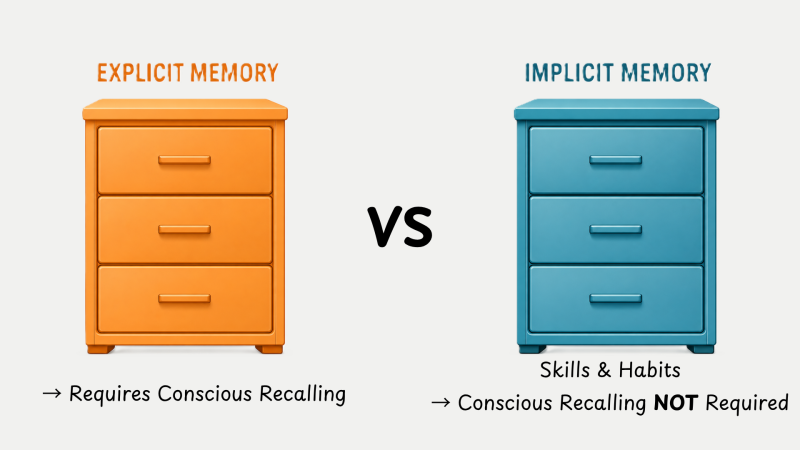
This is all information that we have to purposefully recall. It is known as explicit memory.
Explicit memory includes things such as facts, events and information about ourselves and the world around us.
But there is another type of memory that is less obvious.


Implicit memory
Implicit memory is involved in learning that doesn't necessarily require us to consciously remember an event.
It can include things such as:
- habits & routines
- conditioned responses
- skills and procedures
Think about it: do you remember the day you were taught how to brush your teeth? Probably not. And yet, you've learned the skill even though you may not remember learning it.
And that's part of what makes implicit memory so interesting. You don't necessarily have to consciously remember the event in order to learn from it.
What does this mean for dementia?
One of the important things to understand is that different types of dementia can affect different aspects of memory. By making the assumption that all memory is the same, we miss out on opportunities for more independence and autonomy. If someone cannot remember being shown how to do something, that doesn't necessarily tell us everything about their ability to learn the skill.
Research has demonstrated that people living with dementia can sometimes acquire new information or skills even when they have very limited conscious recollection of the learning experience (e.g.: Heindel et al., 1989; Hirono et al., 1997; Squire & Zola, 1996; Van Halteren-van Tilborg et al., 2007; Voigt-Radloff et al., 2017).
That doesn't mean that everyone with dementia will be able to learn every skill.
It doesn't mean that dementia can be reversed.
And it doesn't mean that memory loss isn't significant.
However, knowing the distinction gives the person living with dementia, and those supporting them, more options in how we approach learning and maintaining familiar skills.
Using a new phone
Imagine teaching someone with dementia how to answer a mobile phone.
You could explain the process:
"When the phone rings, pick it up, press this button and then speak."
You might explain it several times.
But if the person's explicit memory is significantly affected, they may not remember the explanation tomorrow.
It's easy to conclude:
"They can't learn this anymore."
But what if we approached the task differently?
Instead of relying primarily on conscious recall, we could use repetition, consistent cues and practice.
The person hears the phone ring.
They pick it up.
They practise the sequence again.
And again.
Over time, the aim is to make the action increasingly familiar and less dependent on consciously remembering a verbal instruction.
The person may still not be able to explain what they have learned.
But that doesn't necessarily mean that no learning has taken place.
You don't have to figure it all out on your own
Every person living with dementia is different, and what works for one person may not work for another.
If you are living with dementia or are supporting someone with dementia and finding that everyday life is becoming more difficult, I can work with you to explore practical ways to make everyday life more sustainable.
Whether you're trying to maintain independence, support everyday activities, adapt the environment or simply find a better way of managing day-to-day life, we can look at what's happening and work out where changes might help.
If you'd like to explore how I could support you, book your free 30-minute conversation to assess how I can help you.
Did you enjoy the post? Let me know by rating it.
Your feedback will guide me for future blog posts.
References:
Professional Experience
Classes taken at the University of Fribourg
GREAT Cognitive Rehabilitation, online course offered by University of Exeter
Heindel, W., Salmon, D., Shults, C., Walicke, P., & Butters, N. (1989). Neuropsychological evidence for multiple implicit memory systems: A comparison of Alzheimer’s, Huntington’s, and Parkinson’s disease patients. The Journal of Neuroscience, 9(2), 582–587. https://doi.org/10.1523/JNEUROSCI.09-02-00582.1989
Hirono, N., Mori, E., Ikejiri, Y., Imamura, T., Shimomura, T., Ikeda, M., Yamashita, H., Takatsuki, Y., Tokimasa, A., & Yamadori, A. (1997). Procedural Memory in Patients with Mild Alzheimer’s Disease. Dementia and Geriatric Cognitive Disorders, 210–216. https://doi.org/10.1159/000106633
Squire, L. R., & Zola, S. M. (1996). Structure and function of declarative and nondeclarative memory systems. Proceedings of the National Academy of Sciences, 93(24), 13515–13522. https://doi.org/10.1073/pnas.93.24.13515
Van Halteren-van Tilborg, I. A. D. A., Scherder, E. J. A., & Hulstijn, W. (2007). Motor-Skill Learning in Alzheimer’s Disease: A Review with an Eye to the Clinical Practice. Neuropsychology Review, 17(3), 203–212. https://doi.org/10.1007/s11065-007-9030-1
Voigt-Radloff, S., de Werd, M. M. E., Leonhart, R., Boelen, D. H. E., Olde Rikkert, M. G. M., Fliessbach, K., Klöppel, S., Heimbach, B., Fellgiebel, A., Dodel, R., Eschweiler, G. W., Hausner, L., Kessels, R. P. C., & Hüll, M. (2017). Structured relearning of activities of daily living in dementia: The randomized controlled REDALI-DEM trial on errorless learning. Alzheimer’s Research & Therapy, 9(1), 22. https://doi.org/10.1186/s13195-017-0247-9
Disclaimer
This article offers ideas to support wellbeing for people living with dementia and their care partners. Please remember: every person is different. Adapt suggestions to your loved one's abilities and consult healthcare professionals if you're unsure about safety or medical concerns. This article is for general information only and is not a substitute for professional advice or care planning.