

In times of distress, it’s not always easy to know what to do or how to respond.
Is your loved one feeling anxious? Asking for their deceased mum? Pacing and repeating, “What do I do? What do I do?”
These moments can be deeply stressful for care partners — professionals and family members alike.
In theory, we are often encouraged to identify unmet needs or use distraction. However, that's not always easy. First, we have to find an idea, then hope the person will accept our proposition. If the person refuses, my invitation to you is to accept the refusal and give them control. Never underestimate the power of letting the person know they have the right to say no.
These approaches were always adapted to the individual and may not feel appropriate for your loved one — or for you. I am not suggesting you copy them, but rather inviting you to explore what works in your relationship.
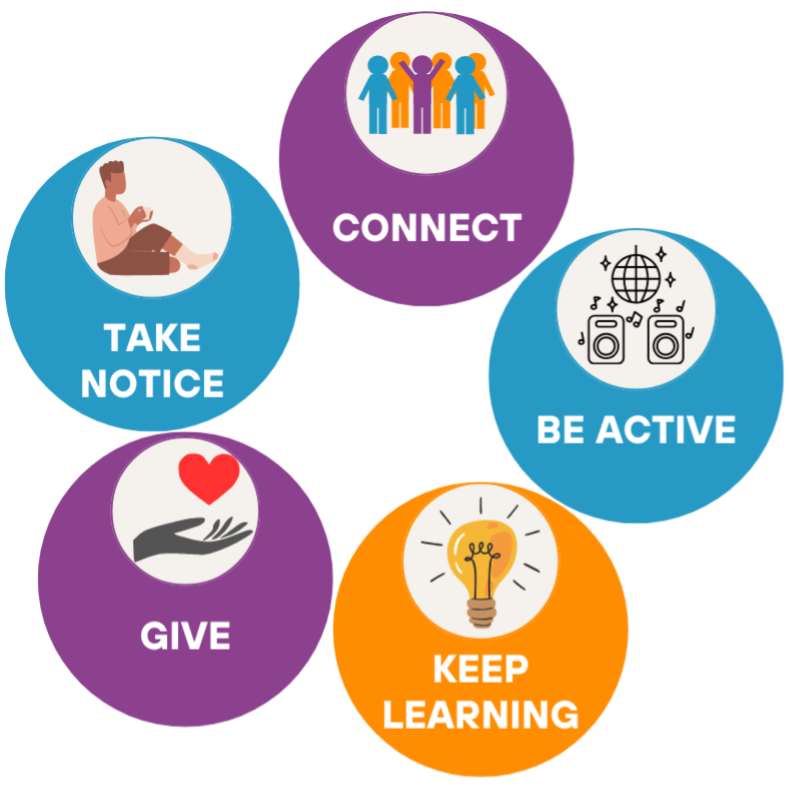
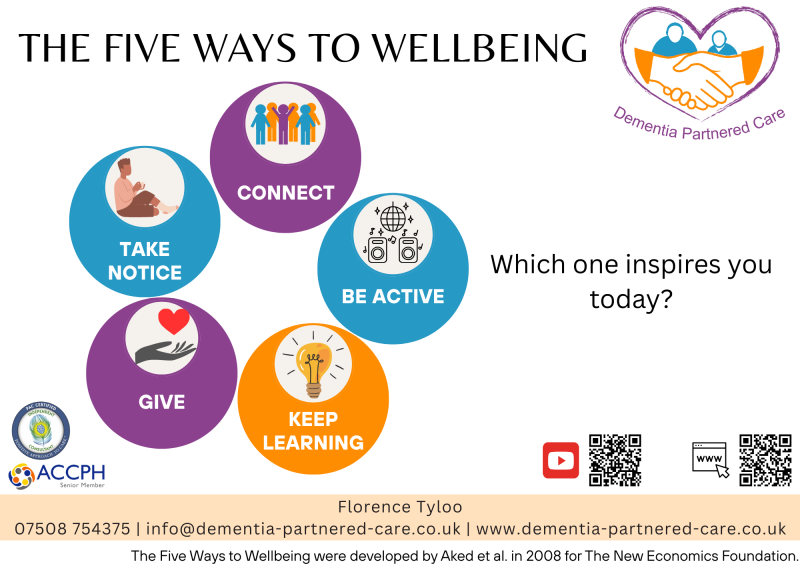
I will use the 5 Ways to Wellbeing as a framework for these engagement strategies.
If you would like to know more about the model, you can read my other blog post HERE.
Connect -- Where is my mom?
When someone repeatedly asks for home or for a loved one who has died, I like to start by validating the feelings behind the words.
“You miss your mum. I bet she’s an amazing person. Can you tell me about her?”
or
“I miss my home too! Where is home for you?”
By starting a conversation around what they are asking for, I leave space for the person to feel heard and seen. Sometimes, that’s all we [humans] need: not rational truth, but the right to dislike something that doesn’t feel right.
And when there is more underneath, the conversation often reveals it.
➡️ Acknowledging the emotion reduces distress more than correcting the facts.
Be Active -- Help!
Have you ever had someone ask for help over and over again? It can make us feel helpless too.
In these moments, I may reverse the roles and ask them to help me.
When preparing coffee, for example, I would invite a resident to guide me through the steps. I was often the one speaking the steps aloud, but I directed them to the person as if I needed their confirmation.
“So, I start by adding sugar in the cups, right?
I’m glad you’re here to help!
We make a great team!”
This gives a sense of purpose, belonging, and competence.
➡️ Purpose can transform anxiety into engagement.
Give - What do I do?
When someone paces and repeats “What do I do?”, giving them a meaningful role can provide direction.
In a care home, I had residents who enjoyed reading aloud in times of distress I would ask them to do me a favour and read to other residents, whom I knew would enjoy that. This gave them a sense of purpose, and the listeners gained connection.
➡️ Giving restores dignity and connection.
Keep Learning -- Teach me your skills
Learning is still possible with dementia, it may take more time, the person may not remember about what they learned, yet it is still possible to learn or re-learn new skills or facts about the world. Have you noticed that?
In times of distress, I’ve used trivia as a way of learning. YouTube has some great trivia videos, which I’ve used when residents were sundowning, for instance.
To me, learning can also be from the perspective of the care partner: what can they teach me? I’ve had residents teach me how to play the piano for instance, or how to play Dominos.
This supports identity, confidence, and relationships.
➡️ Learning reinforces the sense of self.
Take Notice
Every other day, there was a resident who would just send me away as soon as I approached them with their medication. I respected their request to be left alone, knowing that I could come back later for their medication.
In the meantime, I had to help regulate their emotions so that they would eventually agree to take their meds. For this resident, I had two options that almost always worked:
- Their favourite song, which led them to sing and dance.
- A YouTube video of beautiful landscapes and calming music. As soon as they saw the scenery, their mood changed.
➡️ Sensory beauty can regulate emotion when reasoning cannot.
Conclusion
At the heart of all these strategies is the relationship.
When we focus on connection first, we create safety.
When there is safety, the need to fight, flee, or call out often softens.
And in that space, purpose, identity, and calm can re-emerge — for the person living with dementia and for us as care partners.
These are some of the ways I have supported people in times of distress. They are not the only ways and should always be adapted to the person and their care partner’s needs.
If you feel stuck in challenging situations and would like to explore engagement strategies together, you are welcome to book a free getting-to-know-me session HERE.
Which of the 5 Ways to Wellbeing do you use most often — and which one would you like to try more?
Did you enjoy the post? Let me know by rating it.
Your feedback will guide me for future blog posts.
Add comment
Comments