Simple and Engaging Ways to Balance Stress Throughout the Day

Published on 13 April 2026 at 10:26

If you’ve read some of my blog posts, you may have noticed that I am a big fan of the N.U.T.S. model to understand human stressors and how these can impact the stress levels of both care partners and people living with dementia.

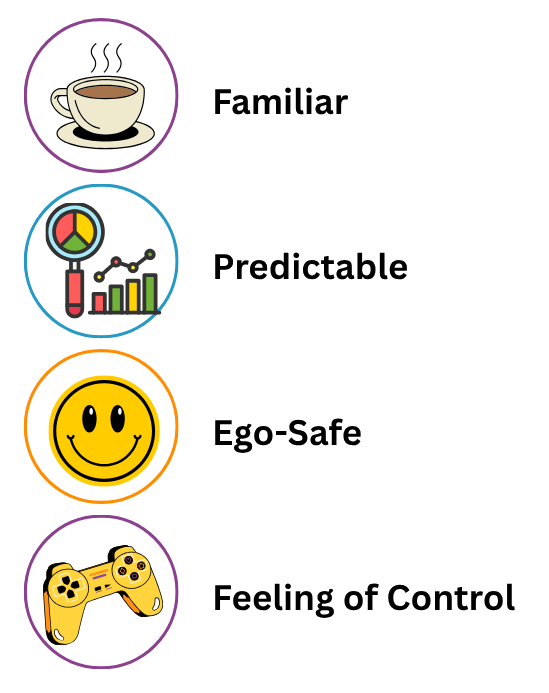
This framework was developed by Sonia Lupien at the Centre for Studies on Human Stress and suggests that psychological stress occurs when at least one of four ingredients is present: Novelty, Unpredictability, Threat to the ego, and low Sense of control.

When I look at dementia through this lens, these ingredients are often present in daily life. This can be due to the way we engage with the person — for example, forgetting to introduce ourselves or speaking too quickly (see my workshop on stress) — as well as to the environment. A lack of contrast may make stairs difficult to navigate, or it may be unclear where to sit on the toilet (see my workshop on visual changes). These small challenges can quietly increase stress throughout the day.

While we can reduce stress by creating environments that offer as much familiarity, predictability, ego-safety, and control as possible, it is unlikely that we can remove all stressors. The same is true in our interactions. Even with the most thoughtful approach, moments of novelty, unpredictability, or reduced control will still occur.

So what can we do?

Rather than trying to eliminate stress or waiting for it to become overwhelming to react, we can create stress-balancing moments throughout the day. These small experiences can help counterbalance psychological strain and prevent stress from becoming overwhelming distress.

In this blog post, I want to share some of the techniques I have used. You can decide what feels appropriate for you, your situation, and your relationship with your teammate living with dementia.

Creating Moments of Familiary, Predictability, Ego-Safety and Control

These are moments when you intentionally engage with the person and provide familiarity, predictability, ego-safety, and control — the opposite of the stress ingredients described in the N.U.T.S. model.

How you do this will depend on your teammate living with dementia.

If they are knowledgeable about something, invite them to share their knowledge. Ask questions about a topic you know they enjoy, ask for help choosing a dinner menu, or ask their opinion about something.

Another example I’ve used has been greeting someone while I had cold hands (use with caution). When my teammate had children or grandchildren, their reaction often was:

“Oh, your hands are cold! Let me warm them up for you.”

While this interaction may seem trivial, it provides a familiar moment (parents and grandparents often warm children’s hands up in winter), something predictable (they know what to do), not just safe but empowering (“I can help with that!”), and control (they decide how to warm my hands).

Small moments like this can quietly balance stress.

Breathing - Singing

Have you ever had someone tell you to “just breathe” when you were stressed?

Breathing is indeed a powerful way to calm the nervous system. However, being told to “just breathe” can sometimes feel dismissive or even increase anxiety when attention is suddenly brought to breathing.

So what could you do instead?

Sing.

Singing naturally encourages deeper, slower breathing, which helps regulate the nervous system. It also adds connection, familiarity, and enjoyment.

There are many ways to use singing with your teammate living with dementia. You might:

  • Play music on YouTube (videos with lyrics on screen can make singing along easier)
  • Ask for help with a song stuck in your head:

“Bob, I need your help! I’ve got this song stuck in my head… (start singing)… What comes next?”

Apart from lowering stress, singing can be a powerful bridge to the person. Many of us have seen moments where someone living with advanced dementia appears more alert and engaged when familiar music is played.

Physical Activity

Stress builds energy in the body. Physical activity can help release this excess energy and lower stress levels.

This could include:

  • Going for a walk
  • Chair exercises
  • Gentle yoga

However, these activities are not always welcomed.

One of my go-to activities has been throwing a balloon back and forth. When playing with a balloon, we’re not only being physically active — we also stay focused on the game. This reduces space for additional worries and helps bring both of us into the present moment.

Simple, playful activities can be surprisingly effective.

Relaxing Time

Finding moments in the day to unwind is important for everyone on the team — whether living with dementia or supporting someone who is.

One of my go-to relaxing activities with teammates is hand massage. If you’ve ever given a hand massage, you may have noticed how relaxing it can be for you as well. The slow movements, the gentle contact, and even the scent of massage oil can help create a calming moment.

Sometimes, when I’m lucky, the person offers to massage me in return — what a treat!

When the weather allows, I may also sit outside with my teammate and simply enjoy the sun. Feeling the warmth on our skin, noticing the wind, or listening to birds can be a gentle way to reduce stress.

These sensory moments can be deeply regulating.

Keep it simple

These stress-balancing moments do not need to be long to be effective. Even one minute can make a difference.

These moments are not meant to add pressure to your day, but rather to take some of that pressure away.

Choose activities you both enjoy. Keep them simple. And allow yourself to have fun with them.

Because sometimes, the smallest moments of familiarity, connection, and control can make the biggest difference — for the person living with dementia, and for us as care partners.
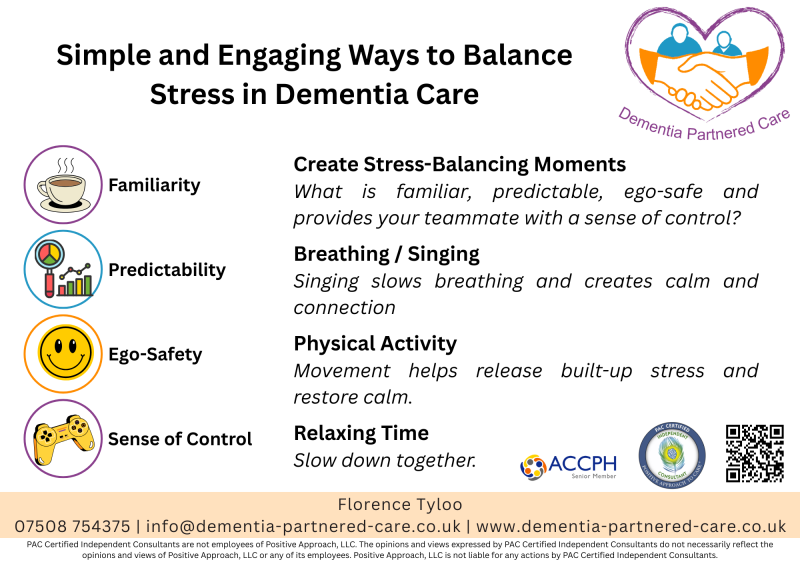

Free Flyer
PDF – 553.6 KB 0 downloads

Did you enjoy the post? Let me know by rating it.
Your feedback will guide me for future blog posts. 

Rating: 5 stars
1 vote

For more information on stress and stress management

  • Check out the research at the Centre for Studies on the Human Stress for more information about the model and ways to cope with stress HERE
  • Buy Sonia Lupien's book Well Stressed: Manage Stress Before It Turns Toxic on Amazon HERE
  • Listen to one of Sonia Lupien's talks on YouTube HERE

Add comment

Comments

There are no comments yet.